
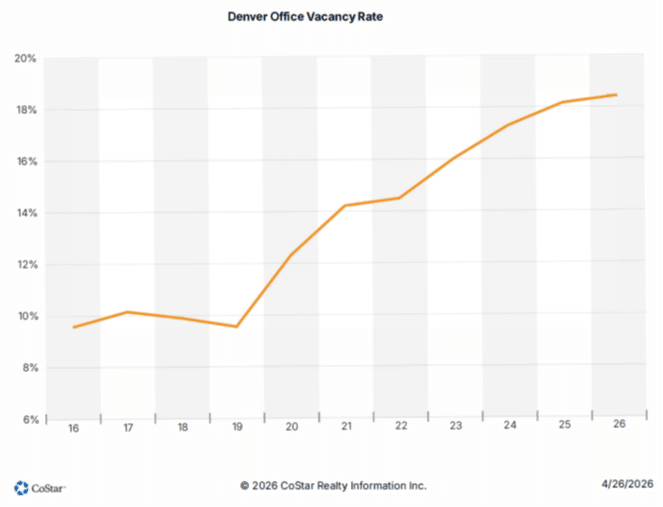
After several years of pandemic-driven disruption, tenants and business owners are asking the same question: Has the Denver office market finally stabilized?
The short answer: not yet, but there are meaningful signs of momentum beneath the surface.
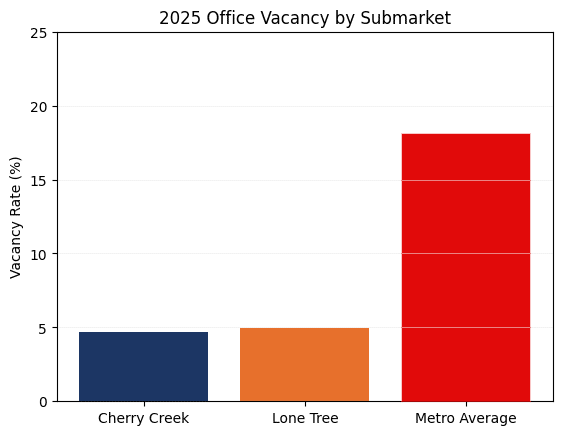
A review of Denver office market 2025 statistics shows metro-wide negative absorption of approximately 1.6 million square feet and an overall vacancy rate of 18.1%, compared to the national average of 14.1%. That vacancy rate remains significantly elevated from pre-COVID levels near 10%.
However, those headline numbers do not tell the whole story.
While certain areas continue to struggle, particularly Downtown Denver, other submarkets such as Cherry Creek and Lone Tree are showing resilience, tenant demand, and tightening vacancy.
For office tenants evaluating renewals, relocations, or expansions, 2026 could represent one of the most strategic leasing environments we’ve seen in years.
Let’s break down what the 2025 Denver office market data really means.
Metro-Wide Denver Office Market Overview (2025)
Key Metrics:
- Negative absorption: 1.6 million SF
- Overall vacancy: 18.1%
- National average vacancy: 14.1%
- Pre-COVID vacancy (approx.): 10%
Negative absorption means more space was vacated than leased in 2025. This continues the broader correction following remote work shifts and tenant downsizing.
However, absorption levels were less severe than peak post-pandemic years indicating the market may be stabilizing.
Submarket Bright Spots in 2025
While the metro average shows softness, submarkets tell a more nuanced story.
Cherry Creek Office Market: Premium Performance
- Vacancy: ~4.7%
- Full-service rents (new buildings): Over $60 PSF
- Average rents: Approximately $43 PSF
Cherry Creek remains one of the strongest office submarkets in the region.
Why?
- Walkable mixed-use environment
- High-end retail and dining
- New Class A product
- Strong appeal to investment firms, private equity, and boutique professional services
Tenants seeking prestige, client-facing visibility, and amenity-rich environments continue to favor Cherry Creek, even at premium rental rates.
This dynamic has pushed rents well above most other Denver submarkets.
What This Means for Tenants:
- Negotiation leverage is limited compared to other areas
- Concessions are tighter
- Renewal strategy must be proactive and early
Lone Tree Office Market: Corporate Stability
- Vacancy: ~5%
- Average full-service rents: ~$34 PSF
Lone Tree has quietly emerged as one of the region’s most stable corporate hubs.
Major corporate occupiers include:
- Charles Schwab
- Kiewit
- Kaiser Permanente
- Cochlear
- Verizon
- Merrill Lynch
A key driver in 2025 was ICR’s purchase and planned occupancy of the 167,000 SF ParkRidge One building, contributing to positive absorption and reducing vacancy to approximately 5%.
Why companies choose Lone Tree:
- Strong access to employees via I-25 and C-470
- Proximity to executive housing
- Nearby amenities including Park Meadows Mall
- Class A space at rents significantly below Cherry Creek
For many tenants, Lone Tree offers a balance of quality, accessibility, and value.
What This Means for Tenants:
- Competitive rents relative to quality.
- Healthy demand but with terms tightening.
- Ideal for corporate relocations and consolidations.
Downtown Denver Office Market: A Gradual Reset
Downtown Denver has faced the most significant challenges post-pandemic.
- Peak negative absorption (2021): 2 million SF
- 2025 absorption: Approximately 65,000 SF negative
- Vacancy (end of 2025): 32% (does not include RiNo or LoDo)
While vacancy remains elevated, the rate of tenant outflow has slowed dramatically compared to earlier years.
Several factors could influence recovery in 2026:
- Completion of 16th Street Mall redevelopment
- Passage of $570 million in city bonds for downtown revitalization
- Increased return-to-office momentum
- Conversion of some obsolete office product to residential
If vacancy has peaked, Downtown may offer the greatest opportunity for tenants seeking leverage.
What This Means for Tenants:
- Significant concession packages available
- Landlords competing aggressively
- Opportunity to upgrade quality without increasing rent
- Ideal conditions for renegotiation
Has the Denver Office Market Turned the Corner?
The answer depends on geography.
Metro-wide numbers still trail national averages. However:
- Suburban nodes are stable
- Premium mixed-use markets are outperforming
- Downtown distress is slowing
- Corporate relocations continue selectively
The broader recovery will likely be uneven but stabilization appears to be underway.
What This Means for Denver Office Tenants in 2026
For business owners evaluating office space, this is not just a statistics conversation, it’s a strategy opportunity.
1. Renewal Leverage Is Real (In Most Submarkets)
Outside of Cherry Creek and Lone Tree, tenants retain negotiating power.
2. Timing Is Right to Lock in Rates
Landlords, particularly in harder hit areas and buildings are ready to make deals. As the office market rebounds, rates should increase more than inflation to make up for years of stagnation.
3. Lease Structuring Matters More Than Rent
Free rent, TI dollars, flexibility clauses, expansion options, and renewal protections often matter more than base rate.
4. Timing Is Critical
Tenants who prepare 9-12 months ahead have the strongest leverage and don’t miss out on opportunities from through research and readiness.
Strategic Advice for Tenants
Before renewing or relocating:
- Conduct a full market survey
- Benchmark concessions across submarkets
- Evaluate flight-to-quality opportunities
- Consider other issues besides rent: Productivity, Retention/Attraction of Talent, Cultural/Purpose Alignment
- Model occupancy cost over the full lease term — not just base rent
- Engage tenant representation early
In today’s environment, strategy beats reaction.
Why Denver Remains Fundamentally Strong
Despite elevated vacancy, Denver retains structural advantages:
- Highly educated workforce
- Strong technology and professional services base
- Lifestyle appeal (sunshine, mountains, outdoor access)
- Lower cost of living compared to major coastal metros
- Entrepreneurial business culture
Markets are cyclical. Fundamentals matter long term.
The Bottom Line
The Denver office market 2025 update shows softness at the metro level but also clear pockets of strength and overall improvement.
For tenants, this is not a time to wait.
It is a time for leverage and action.
And those who plan strategically in 2026 may secure the best lease terms available over the coming five years.
Free 2026 Denver Office Tenant Strategy Session
If your lease expires in the next 24 months, now is the time to evaluate your options.
We help Denver tenants:
- Negotiate renewals
- Evaluate relocation options
- Compare submarkets
- Structure favorable lease terms
Schedule a complimentary lease strategy consultation